
Validation against the survey package
Source:vignettes/validation-against-survey.Rmd
validation-against-survey.Rmdweightflow’s calibration is meant to reproduce the established
results of the survey package on every method they share,
while adding the staged cascade (eligibility, nonresponse, selection)
and a recipe-aware bootstrap on top. This vignette checks that agreement
directly and visually: on the same starting weights and the same control
totals, the two packages return the same weights
for
- post-stratification, raking and linear (GREG) calibration;
- the three calibration distance functions (linear, raking/exponential, logit);
- integrative calibration (one weight per household); and
- domain (partitioned) calibration.
Each method is shown with a scatter of the g-weights
(adjustment factors, g = final / base) of the two packages
against the y = x line; we also plot the
distribution of those adjustment factors and close with
a table of estimates. To make every unit comparable
one-to-one, the recipes below use only the calibration step (no dropping
or nonresponse), so no rows are removed.
d   <- sample_survey
pop <- population

# a demographic breakdown gives the calibration more auxiliary variables
brk <- c(0, 30, 45, 60, Inf); lab <- c("18-30", "31-45", "46-60", "60+")
d$age_grp   <- cut(d$age,   brk, labels = lab)
pop$age_grp <- cut(pop$age, brk, labels = lab)

# tidy population margins reused throughout
reg_tab <- as.data.frame(table(region  = pop$region))
sex_tab <- as.data.frame(table(sex     = pop$sex))
age_tab <- as.data.frame(table(age_grp = pop$age_grp))

# model-matrix totals for the region + sex + age-group calibration
totals  <- colSums(model.matrix(~ region + sex + age_grp, pop))
# weightflow brand palette (from the pkgdown site)
wf_primary <- "#3d3580"; wf_violet <- "#7a6ad0"
wf_green   <- "#1d9e75"; wf_amber  <- "#c9822b"; wf_grey <- "#6b7280"

theme_wf <- function() {
  ggplot2::theme_minimal(base_size = 11) +
    ggplot2::theme(
      plot.title    = ggplot2::element_text(face = "bold", colour = wf_primary),
      plot.subtitle = ggplot2::element_text(colour = wf_grey, size = 9),
      axis.title    = ggplot2::element_text(colour = wf_grey),
      legend.position = "top",
      panel.grid.minor = ggplot2::element_blank())
}

# Helper: numeric agreement + the OVERLAP of the two g-weight (adjustment factor,
# g = final / base) distributions. Because the two packages agree, the survey and
# weightflow densities land exactly on top of each other.
agree <- numeric(0)                                   # collect max|diff| per method

compare <- function(w_sv, w_wf, label, base = d$pw) {
  diff <- max(abs(w_wf - w_sv))
  agree[[label]] <<- diff                             # store for the final table
  if (has_ggplot) {
    g <- rbind(data.frame(package = "survey",     g = w_sv / base),
               data.frame(package = "weightflow", g = w_wf / base))
    print(ggplot2::ggplot(g, ggplot2::aes(g, fill = package, colour = package)) +
      ggplot2::geom_density(alpha = 0.4, linewidth = 0.5) +
      ggplot2::scale_fill_manual(values = c(survey = wf_amber, weightflow = wf_violet)) +
      ggplot2::scale_colour_manual(values = c(survey = wf_amber, weightflow = wf_violet)) +
      ggplot2::labs(title = label,
                    subtitle = sprintf("g-weights overlap (survey vs weightflow) · max |w_wf - w_sv| = %.1e", diff),
                    x = "g (adjustment factor)", y = "density", fill = NULL, colour = NULL) +
      theme_wf())
  }
  invisible(diff)
}
Post-stratification
Post-stratifying to the joint population counts of
region × sex.
library(survey)
#> Loading required package: grid
#> Loading required package: Matrix
#> Loading required package: survival
#>
#> Attaching package: 'survey'
#> The following object is masked from 'package:graphics':
#>
#>     dotchart
ps_tab <- as.data.frame(table(region = pop$region, sex = pop$sex))

wf <- weighting_spec(d, base_weights = pw) |>
  step_calibrate(method = "poststratify", totals = ps_tab, count = "Freq") |>
  prep()
w_wf <- wf$final_weight

des    <- svydesign(ids = ~1, weights = ~pw, data = d)
des_ps <- postStratify(des, ~region + sex, ps_tab)
w_sv   <- weights(des_ps)

compare(w_sv, w_wf, "Post-stratification (region x sex)")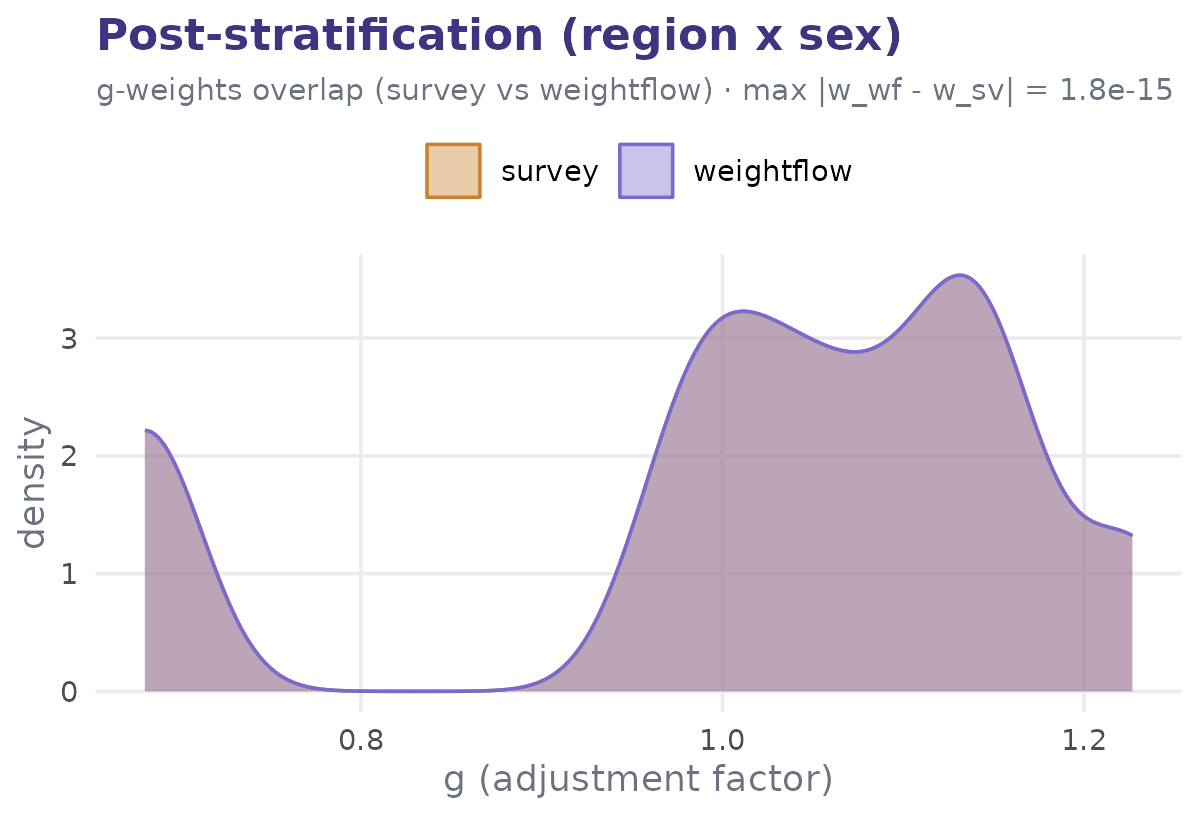
Raking
Raking (iterative proportional fitting) to the region,
sex and age_grp margins. We tighten
survey’s convergence so both solve to the same
precision.
wf <- weighting_spec(d, base_weights = pw) |>
  step_calibrate(method = "raking", totals = list(reg_tab, sex_tab, age_tab),
                 count = "Freq") |>
  prep()
w_wf <- wf$final_weight

des_rk <- rake(des, list(~region, ~sex, ~age_grp), list(reg_tab, sex_tab, age_tab),
               control = list(epsilon = 1e-10, maxit = 100))
w_sv   <- weights(des_rk)

compare(w_sv, w_wf, "Raking (region + sex + age group)")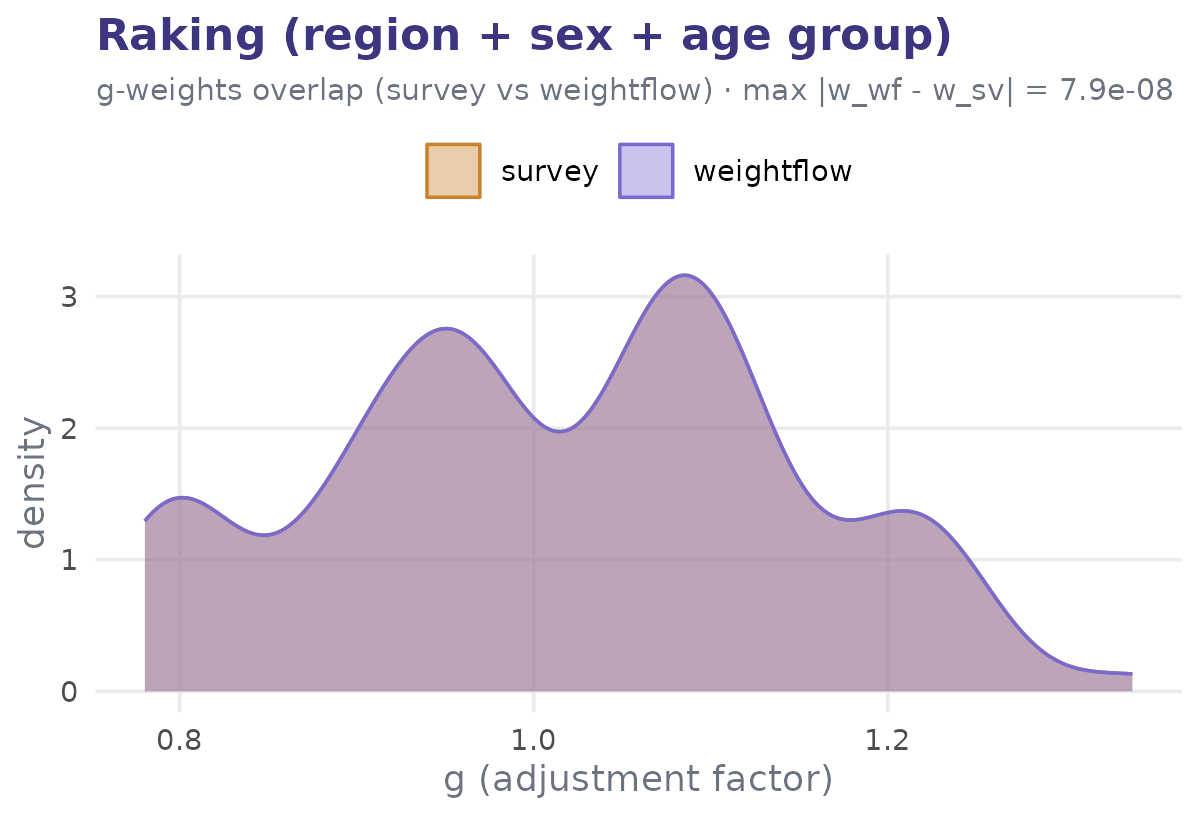
Calibration distances
Linear/GREG calibration to the totals of
~ region + sex + age_grp can be solved with any of the
three distance functions. weightflow’s calfun maps
one-to-one onto survey’s calfun. We keep the
g-weights from each to compare their distributions afterwards.
Linear (chi-square) distance – the GREG estimator
wf <- weighting_spec(d, base_weights = pw) |>
  step_calibrate(method = "linear", formula = ~ region + sex + age_grp,
                 totals = totals, calfun = "linear") |>
  prep()
w_wf <- wf$final_weight
w_sv <- weights(calibrate(des, ~ region + sex + age_grp, population = totals,
                          calfun = "linear"))
g_linear <- w_wf / d$pw
compare(w_sv, w_wf, "Distance: linear (GREG)")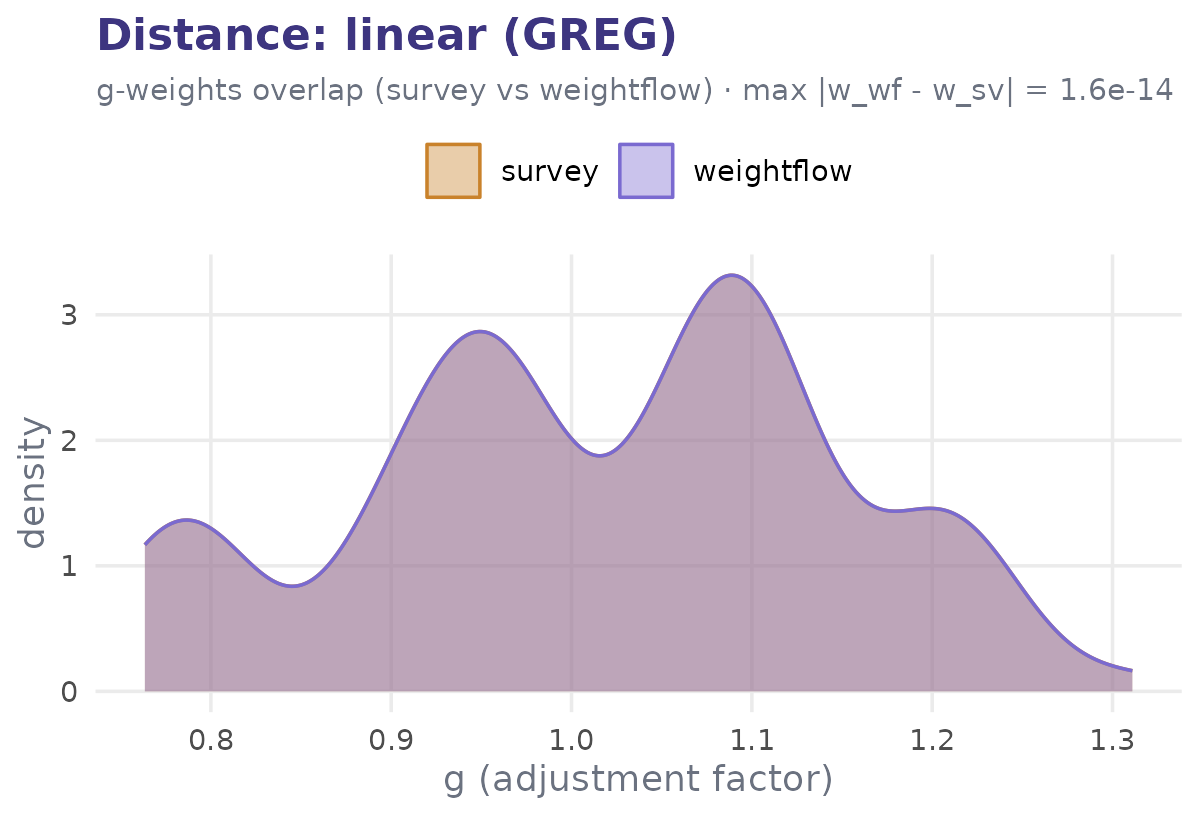
Raking (exponential) distance – always-positive weights
wf <- weighting_spec(d, base_weights = pw) |>
  step_calibrate(method = "linear", formula = ~ region + sex + age_grp,
                 totals = totals, calfun = "raking", maxit = 500, tol = 1e-10) |>
  prep()
w_wf <- wf$final_weight
w_sv <- weights(calibrate(des, ~ region + sex + age_grp, population = totals,
                          calfun = "raking", maxit = 500, epsilon = 1e-10))
g_raking <- w_wf / d$pw
compare(w_sv, w_wf, "Distance: raking (exponential)")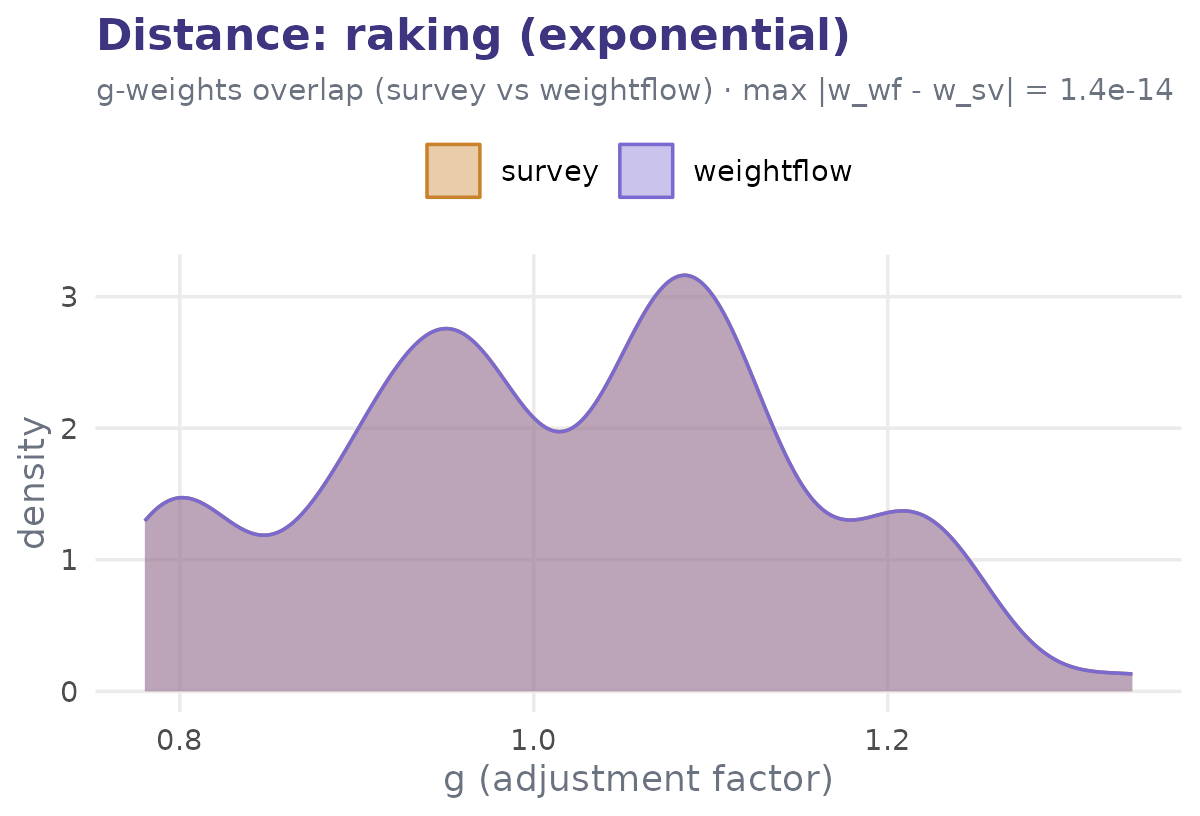
Logit distance – bounded g-weights
bnds <- c(0.5, 2)
wf <- weighting_spec(d, base_weights = pw) |>
  step_calibrate(method = "linear", formula = ~ region + sex + age_grp,
                 totals = totals, calfun = "logit", bounds = bnds,
                 maxit = 500, tol = 1e-10) |>
  prep()
w_wf <- wf$final_weight
w_sv <- weights(calibrate(des, ~ region + sex + age_grp, population = totals,
                          calfun = "logit", bounds = bnds, maxit = 500, epsilon = 1e-10))
g_logit <- w_wf / d$pw
compare(w_sv, w_wf, "Distance: logit (bounded)")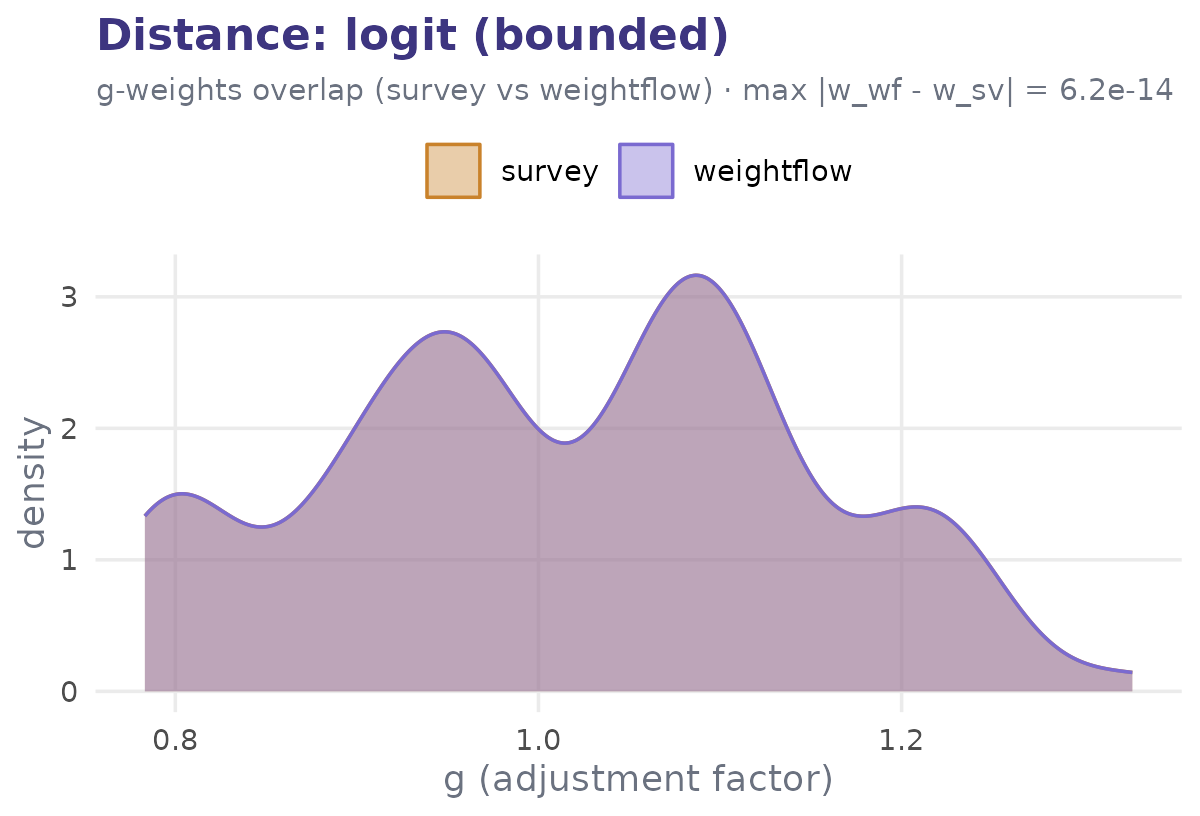
Distribution of the adjustment factors
The distance function shapes how far the weights move. The linear
distance is symmetric (and can dip below the dashed line at
g = 1), raking keeps every weight positive, and logit is
bounded by construction.
gdist <- rbind(
  data.frame(distance = "linear", g = g_linear),
  data.frame(distance = "raking", g = g_raking),
  data.frame(distance = "logit",  g = g_logit))
gdist$distance <- factor(gdist$distance, levels = c("linear", "raking", "logit"))

ggplot2::ggplot(gdist, ggplot2::aes(g, fill = distance)) +
  ggplot2::geom_density(alpha = 0.4, colour = NA) +
  ggplot2::geom_vline(xintercept = 1, linetype = "dashed", colour = wf_grey) +
  ggplot2::scale_fill_manual(values = c(linear = wf_primary, raking = wf_green,
                                        logit = wf_amber)) +
  ggplot2::labs(title = "Distribution of adjustment factors",
                subtitle = "g = final / base, by calibration distance",
                x = "g (adjustment factor)", y = "density", fill = NULL) +
  theme_wf()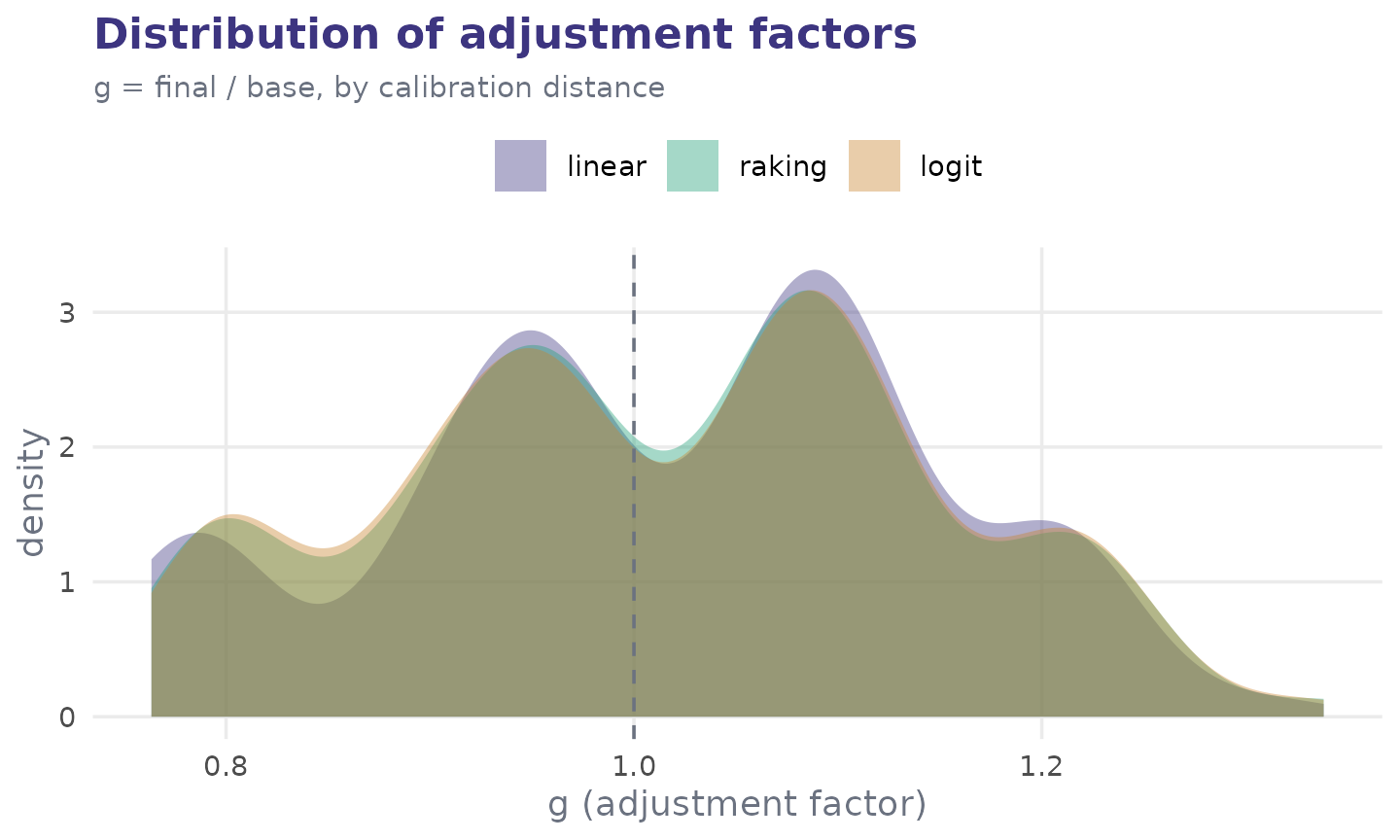
Integrative calibration (one weight per household)
When every person in a household must carry the same weight,
weightflow uses the Lemaitre-Dufour (1987) integrative method
(cluster = "household_id", equal_within_cluster = TRUE).
survey reaches the same result through
aggregate.stage (Vanderhoeft 2001). The base weight
pw is constant within household here, so the constraint is
well defined.
wf <- weighting_spec(d, base_weights = pw) |>
  step_calibrate(method = "linear", formula = ~ region + sex + age_grp,
                 totals = totals, cluster = "household_id",
                 equal_within_cluster = TRUE) |>
  prep()
w_wf <- wf$final_weight

des_hh  <- svydesign(ids = ~household_id, weights = ~pw, data = d)
des_int <- calibrate(des_hh, ~ region + sex + age_grp, population = totals,
                     calfun = "linear", aggregate.stage = 1)
w_sv    <- weights(des_int)

within_hh <- max(tapply(w_wf, d$household_id, function(z) diff(range(z))))
cat("max within-household weight range (weightflow):", within_hh, "\n")
#> max within-household weight range (weightflow): 0

compare(w_sv, w_wf, "Integrative (one weight per household)")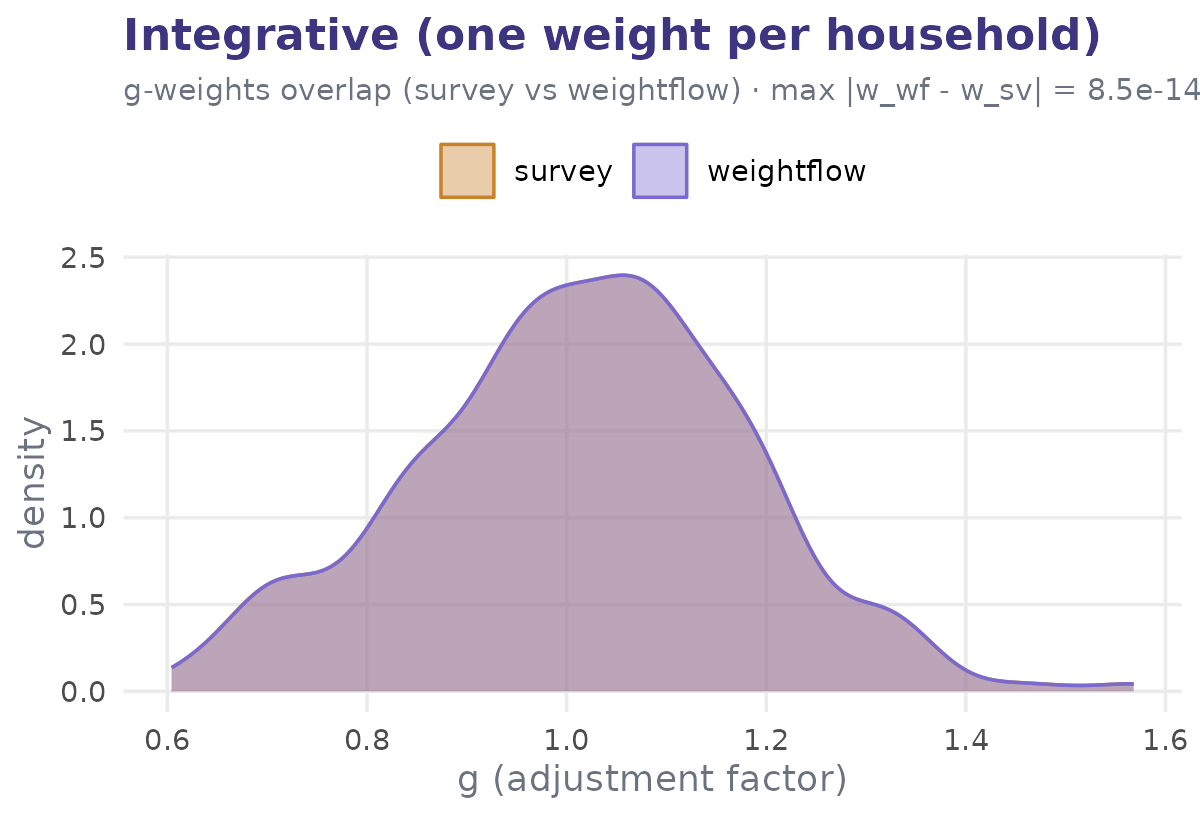
Domain (partitioned) calibration
weightflow can calibrate each domain independently to its own totals
in a single call with by =. Here each region is calibrated
to its own sex and age_grp distributions;
survey reaches the same weights by calibrating one region
at a time.
sex_by_region <- as.data.frame(table(region = pop$region, sex     = pop$sex))
age_by_region <- as.data.frame(table(region = pop$region, age_grp = pop$age_grp))

wf <- weighting_spec(d, base_weights = pw) |>
  step_calibrate(method = "linear", formula = ~ sex + age_grp,
                 totals = list(sex = sex_by_region, age_grp = age_by_region),
                 count = "Freq", by = "region") |>
  prep()
w_wf <- wf$final_weight

w_sv <- numeric(nrow(d))
for (r in levels(d$region)) {
  idx   <- which(d$region == r)
  des_r <- svydesign(ids = ~1, weights = ~pw, data = d[idx, ])
  tot_r <- colSums(model.matrix(~ sex + age_grp, pop[pop$region == r, ]))
  w_sv[idx] <- weights(calibrate(des_r, ~ sex + age_grp, population = tot_r,
                                 calfun = "linear"))
}

compare(w_sv, w_wf, "Domain calibration (by region)")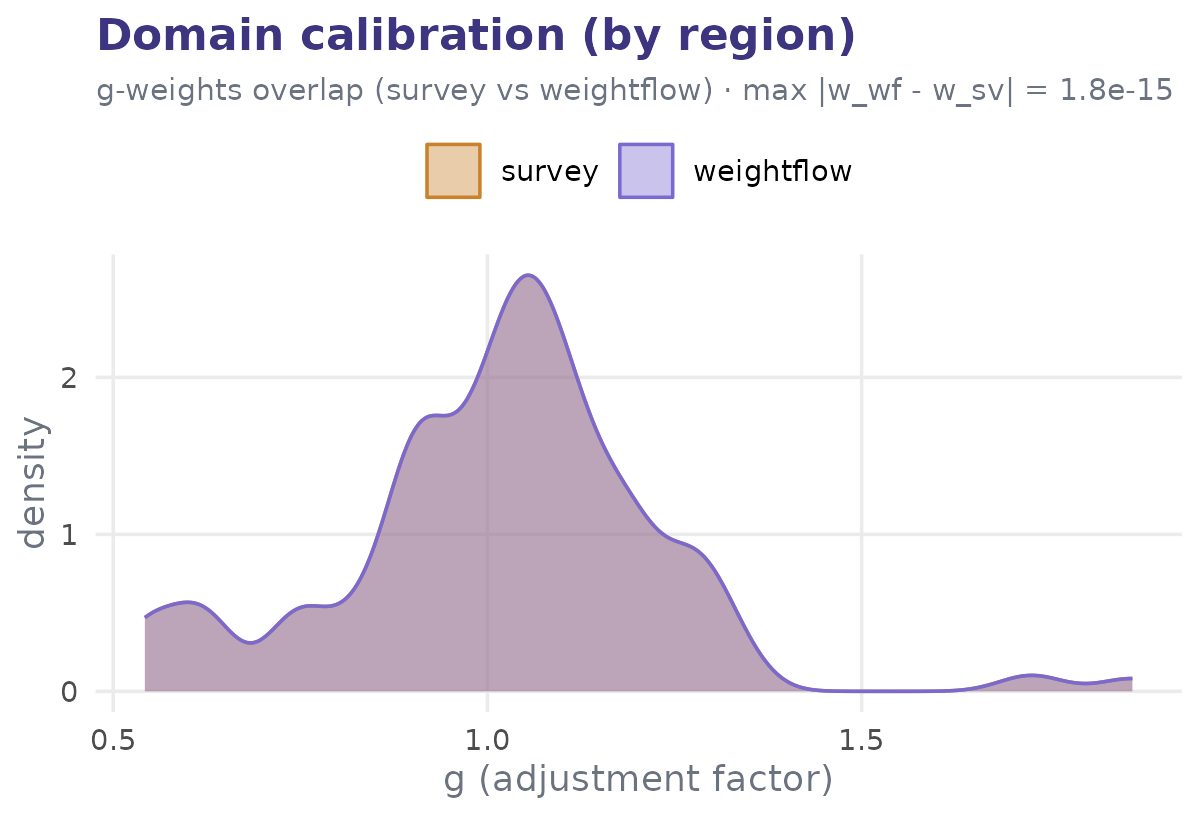
Estimates agree too
Because the weights coincide, so do the estimates. Using the
raking-calibrated weights, we estimate a survey outcome (respondent
age) both ways and compare in a single table:
wf <- weighting_spec(d, base_weights = pw) |>
  step_calibrate(method = "raking", totals = list(reg_tab, sex_tab, age_tab),
                 count = "Freq") |>
  prep()
w_wf   <- wf$final_weight
des_rk <- rake(des, list(~region, ~sex, ~age_grp), list(reg_tab, sex_tab, age_tab),
               control = list(epsilon = 1e-10, maxit = 100))

est <- data.frame(
  quantity   = c("mean(age)", "total(age)"),
  weightflow = c(weighted.mean(d$age, w_wf), sum(w_wf * d$age)),
  survey     = c(as.numeric(coef(svymean(~age, des_rk))),
                 as.numeric(coef(svytotal(~age, des_rk)))))
est$difference <- est$weightflow - est$survey
est
#>     quantity   weightflow       survey    difference
#> 1  mean(age)     42.38993     42.38993 -4.130882e-10
#> 2 total(age) 190542.74882 190542.74882 -1.856853e-06
The design-based standard errors (from survey, or from
weightflow’s recipe-aware bootstrap) are the subject of the Variance
estimation article; here the point is that the calibrated point
estimates are the same.
Agreement summary
Across every method and distance, weightflow reproduces
survey to numerical tolerance. The closed-form methods
(post-stratification, linear) agree to machine precision; the iterative
ones (raking, logit, integrative) agree to the shared convergence
tolerance.
data.frame(method = names(agree), `max abs weight difference` = unname(agree),
           check.names = FALSE, row.names = NULL)
#>                                   method max abs weight difference
#> 1     Post-stratification (region x sex)              1.776357e-15
#> 2      Raking (region + sex + age group)              7.927345e-08
#> 3                Distance: linear (GREG)              1.598721e-14
#> 4         Distance: raking (exponential)              1.421085e-14
#> 5              Distance: logit (bounded)              6.217249e-14
#> 6 Integrative (one weight per household)              8.526513e-14
#> 7         Domain calibration (by region)              1.776357e-15
Trimmed calibration matches ReGenesees
Range-restricted trimming of calibrated weights
(step_trim_calibrated()) also agrees with an established
reference: ReGenesees trimcal(). Both take absolute bounds
on the final weight (weightflow lower/upper,
ReGenesees w.range), trim to that range while preserving
the calibration totals, and return the same solution. On a calibration
to ~ sex + age trimmed to a fixed interval, the two agree
to machine precision (maximum absolute weight difference about 1e-8,
correlation 1), with both preserving the population totals. The
comparison is not run here because ReGenesees is not a dependency; the
script trim_calibrated_vs_regenesees.R reproduces it.
# weightflow
w_wf <- muestra |>
  weighting_spec(base_weights = pw) |>
  step_calibrate(method = "linear", formula = ~ sex + age, totals = pop_tot) |>
  step_trim_calibrated(~ sex + age, lower = lo, upper = up, calfun = "linear") |>
  prep() |> collect_weights(drop_zero = FALSE)

# ReGenesees
des   <- ReGenesees::e.svydesign(data = muestra, ids = ~ id, weights = ~ pw)
templ <- ReGenesees::fill.template(universe = universo,
           template = ReGenesees::pop.template(des, calmodel = ~ sex + age))
cal   <- ReGenesees::e.calibrate(des, df.population = templ, calfun = "linear")
w_rg  <- weights(ReGenesees::trimcal(cal, w.range = c(lo, up)))
What weightflow adds
The point of agreement is trust: where the methods overlap,
weightflow returns exactly what survey does. On top of that
shared core, weightflow contributes the staged cascade
(unknown eligibility, ineligible dropping, within-household selection,
and person- or household-level nonresponse, each as a pipeable step with
diagnostics), the tidy totals and
domain interfaces shown above, and a bootstrap
that re-applies the whole recipe on each replicate, so the
variance reflects every adjustment (see the Variance estimation
article). For design-based inference you can always export the final
weights back to survey/srvyr. ```